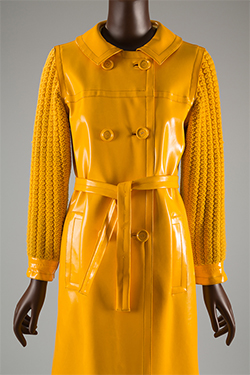
Marigold vinyl with knitted sleeves — couture’s answer to the boutique.
Details
February 10 – April 15, 2017
The Museum at FIT
Special Exhibitions Gallery
New York, NY
Links & Downloads

In 1957, twenty-one-year-old Yves Saint Laurent was promoted to creative director of the couture house of Christian Dior. Saint Laurent’s first solo collection for Dior included his A-line “trapeze” dresses, ushering in an unmistakable shift toward more relaxed and, ultimately, more youthful designs — and with it, drastic changes to the couture fashion industry that are rarely explored in depth.
Paris Refashioned, 1957–1968 highlighted one of the most groundbreaking time periods in fashion history. While many books and exhibitions about this era position London as the center of innovative, youth-oriented design, this limited perspective overlooks the significant role that Paris continued to play in the fashion industry.
Paris Refashioned, 1957–1968 also examined the combined influence of French haute couture, ready-to-wear, and popular culture during this era, with particular emphasis on how fashion was perceived and promoted by the American fashion press. All objects on view were selected from The Museum at FIT’s permanent collection of more than 50,000 objects.
On making it
I have loved 1960s fashion since I was a child, when I found a copy of Joel Lobenthal’s book Radical Rags: Fashions of the Sixties at my local library. More than a decade later, I wrote my master’s thesis on the French yé-yé singers and style icons, Françoise Hardy and Sylvie Vartan. I was also working as an intern at The Museum at FIT during that time, and just beginning to explore the museum’s vast collections of clothing and accessories. I was excited to discover that these included excellent examples of work by designers associated with the yé-yé movement, such as André Courrèges, Emmanuelle Khanh, Sonia Rykiel, and Yves Saint Laurent.
Paris Refashioned, 1957–1968 features work from these designers and many more. Although my past research on the fashions of the yé-yé girls was important to this project, the exhibition takes a larger perspective, emphasizing the shift within the 1960s fashion industry from the unassailable dominance of haute couture to the newfound influence of ready-to-wear.
Colleen Hill
From “Welcome to Paris Refashioned, 1957–1968,” written for The Museum at FIT website, February 10, 2017.
More views
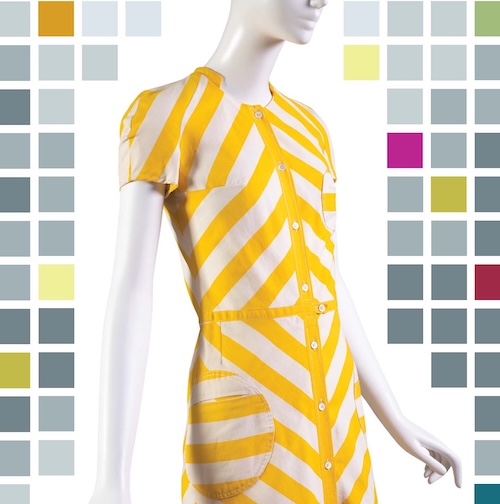
Mitred stripes, and a curved pocket.
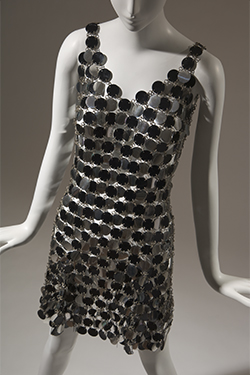
Linked discs, silver and black.
Press
“MFIT has a wealth of fashion history’s stars, like a ‘Trapeze’ dress from Yves Saint Laurent’s spring 1958 couture collection for Christian Dior and one of Paco Rabanne’s plastic disc dresses, but for me it’s the lesser-known pieces that provide the most informative story.”
Sarah C. Byrd, “Exhibition Review: Paris Refashioned, 1957–1968” · April 2, 2017
“When Christian Dior died in 1957, after ten years in which the West happily heeled to his whiplash fashion decrees, a replacement was already in the wings, the twenty-one-year-old Yves Saint Laurent.”
Laura Jacobs, “The French Revolution in Fashion” · February 21, 2017
“The main gallery, which addresses the rivalry between ready-to-wear and couture-only designers in the ’60s, is staged to look like a boutique-dotted Paris street. . . . Dress forms vary wildly, with some garments displayed on vintage wooden busts with articulated arms and others on more modern, monochrome mannequins.”
Anna Furman, “A New Exhibit of 1960s Paris Fashion Reminds Us That Everything Is Cyclical” · February 12, 2017